Tuesday, 29 May 2018

MY FAVOURITE STREET ARTIST


STIK

I prefer Stik's works because he paints simple figures only with sticks, but he can represents a lot of scenes with easy elements.

In his works, he wants to show the strength when you join together with other people, to be with your parents, the baby's fragility...

He's my favourite street artist toobecause he also uses a big variety of colours, and he draw on high places. 

 Resultado de imágenes de stik street artist union  Resultado de imagen de stik street artist baby sleeping 

                                          Ver las imágenes de origen

Saturday, 26 May 2018

MY ARTS' WORKS

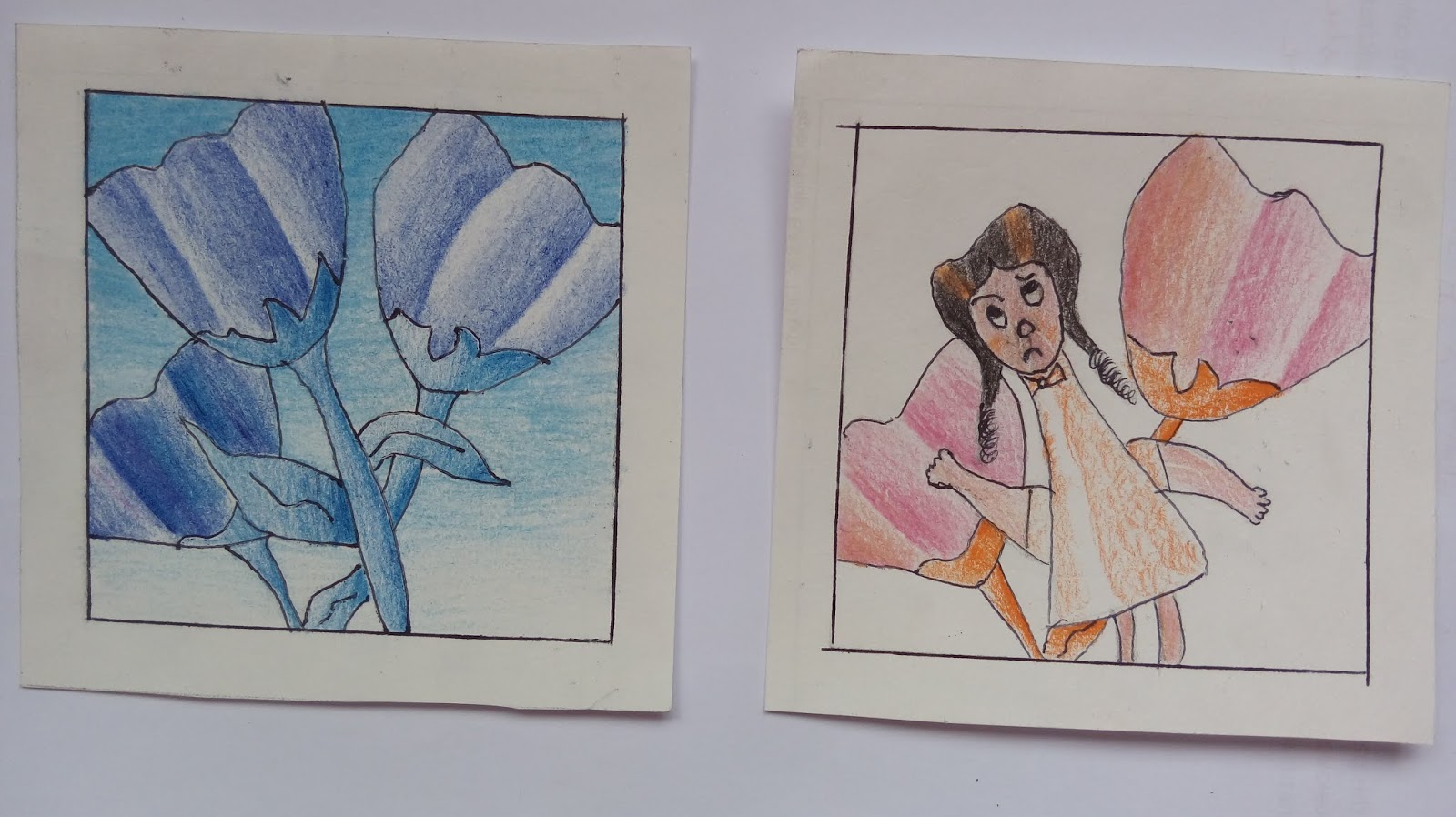
COLD COLOURS AND ARTIST WORK


Tuesday, 13 March 2018

VOCABULARY ABOUT SYMMETRY, LINES AND VISUAL REPRESENTATION

THE SYMMETRY

Symmetry: Is when some shapes are a reflection of other. It´s only on same shapes.

Reflection symmetry: Is a quality of same shapes that consists in having an axis between two shapes, and it's like when you see you in a mirror.

Symmetry axis: Is when a line divides in two symmetrical parts. Every element of the shape is represented in the other part at the same distance from the axis. Symmetrical points are on perpendicular lines to it.


Central symmetry: Its a reflection of a shape without an axis, so there is a symmetry centre. Every element of the shape is represented in the other part at the same distance from the symmetry centre. Symmetrical points are collinear with the centre.


Geometric symmetry: Is a kind of symmetry which follows accurately (presition9 the geometric symmetry rules.

Apparent symmetry: Is a quality of shapes or objectswhich shows an obvious symmetry, but not every elements follows this rules. It happens very frecuently in nature.


Symmetrical balance: Is a way to organize parts of an image, picture or drawing, so one side mirrors (duplicates) the other. The opposite way is called Asymmetrical balance.


BASIC ELEMENTS OF 
VISUAL REPRESENTATION

Dot: Is the smallest and the most simple element in art expression. Its first target is to indicate a position since it doesn't follows any direction It may have different qualities such a size, shape and colour. 
          -The dot's three dimensional capacities: When size, shapes and colours are changed, the dots can create visual sensations of spacial deepness.
          -The dot's expresive capacity: The point has an unlimited capacity to represent images and to express ideas and emotions. To do so, visual effects are used.

Optical mix: Is when colours are mixed with the help of distance. Paint isn't mixed on the palette and on the painting.


VOCABULARY ABOUT LINES

Lines: It can be defined as a dot in movement. It has position and direction in the space, and of the principal functions consists on marking the shapes' outlines.

Zigzag/Broken lines: They are formed by several fragments of straight lines with directions.

Wavy lines: They are formed by several fragments of curved lines.

Curly lines: They hold more curved than wavy lines and show loops.

Scribble: Chaotic lines that are traced randomly, usually to fill some area with a particular texture.

Hatching: Is a way of shading on areas of objects or surfaces with parallel lines.

Cross-hatching: Is a way of shading on areas of objects or surfaces with parallel lines in several directions.

Dashed/Dotted lines: There are lines that are not continuous, formed by little traces or dots.

Blurred: They are very soft so you can put shadowsto intense and deep.

Simple lines: They are formed by only one line.

Composite lines: They are lines composed by fragmets of several straight or curved lines.

Wednesday, 7 March 2018

HEALTHY BREAKFAST


HEALTHY BREAKFAST

The ingredients are: milk, strawberries, bread and jam.


 In the first part, we cut the stawberries.


Then, we put it in the mixer with the milk.


We beat both ingredients.


We put it in a glass.


Now we do the second part. We toast the bread.


We spread the toasted bread with jam.


And now, ¡it´s time to eat!


Monday, 11 December 2017


SELF-ASSESSEMENT


What can I do that I coulden´t do before?
I can do my own blog.

What do I like most?
Learning about new things and words that I didn´t know before.

What do I do well?
Remember vocabulary and words.

What am I confused about?
Nothing, because my teachers help me with the questions that I had.

What do I need help with?
With some vocabulary and with some things of the blog.

What do I do in English outide the class?
I study English, I watch some TV in English and I go to English classes to an academy.

What do I need to improvise?
All the texts and the homework that teachers say me.

What did I learn about culture?
New things that I didn´t know before. 
For example:

Write a postcode in English.
Know about strange houses in the United States.
          ...

Sunday, 3 December 2017

MY IDEAL HOUSE

My ideal house would be huge, with a lot of windows, with a ground floor, a basement, a garage, two
floors, a terrace, a balcony and an attic. It has got a swimming pool, a trampoline, a tennis court and a basketball court. It has got five bathrooms, and six bedrooms, a garden, a dinning room and an enormous living room. It has got a space for pets, because I want to have three little dogs. I want to have a huge jacuzzi too, for all my family. I want to have this house near the beach, to go there on my summer holidays.